
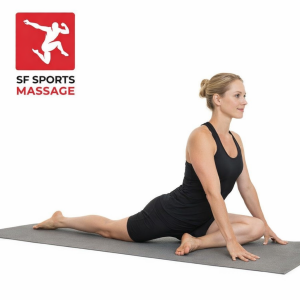
Why stretching the glutes improves glute function
Stretching the glutes isn’t just about “loosening tight muscles.” It actually restores the conditions the glutes need to fire properly, stabilise the pelvis, and produce force.
1. It resets the length–tension relationship
When the glutes are chronically shortened (from sitting, driving, or training without mobility work), the muscle fibres sit in a position where they can’t generate force efficiently. A simple stretch restores optimal resting length, which means the glutes can contract harder and more cleanly.
2. It reduces neural inhibition
Tight glutes often create protective tension around the hip. That tension sends a message to the nervous system: “Don’t let this muscle work too hard.” Stretching reduces that protective tone, allowing the brain to re‑activate the glutes instead of shutting them down.
3. It improves hip mechanics
Restricted glutes limit hip flexion, extension, and rotation. When you restore mobility, the hip can move through its full arc, which means the glutes can:
- Load properly
- Lengthen under control
- Recoil with power
Better movement = better activation.
4. It stops compensations from taking over
When the glutes can’t lengthen, other muscles jump in:
- TFL
- Piriformis
- Hamstrings
- Lumbar erectors
Stretching the glutes reduces the need for these compensators, so the glutes can take back their job.
5. It improves blood flow and recovery
A stretched muscle receives better circulation. Better circulation = better oxygen delivery = better contraction quality.
By Savva Filactou — Sports Massage Practitioner helping clients recover, move better, and stay injury‑free.